LED strip lighting is one of the most versatile products in modern lighting design. From under-cabinet task lighting in the kitchen to cove lighting in the living room, staircase accents, and outdoor entertaining areas — strips can do it all. But with so many options on the market, knowing what to buy can be overwhelming.
This guide covers everything you need to know: how LED strips work, what specs matter, where to use them, and how to buy the right one for your project.
What Is LED Strip Lighting?
LED strip lighting (also called LED tape or ribbon lighting) is a flexible circuit board populated with small LED chips, typically supplied on a reel. They're low voltage (usually 12V or 24V DC), energy-efficient, and available in a wide range of colours, colour temperatures, and brightness levels.
Most LED strips are cut-to-length, making them highly adaptable to almost any space or application.
Key Specs to Understand Before You Buy
Colour Temperature
Colour temperature determines the warmth or coolness of the light emitted:
- Warm White – 3000K: Cosy and residential. Ideal for living rooms, bedrooms, kickboard lighting, and cove lighting where a warm, inviting glow is desired.
- Cool White – 4000K: Crisp and modern. Popular for kitchen benchtops, bathrooms, and workspaces where clarity and brightness matter.
- Daylight – 5000K+: Very bright and clinical. Best suited to commercial or task-heavy environments.
Pro tip: Match your LED strip colour temperature to your downlights and other fittings for a cohesive look throughout the space.
CRI (Colour Rendering Index)
CRI measures how accurately a light source renders colours compared to natural daylight, on a scale of 0–100. For residential applications, always look for a CRI of 90+. This is especially important in kitchens and bathrooms where accurate colour rendering matters — for food preparation, makeup, and styling.
Lumens per Metre (lm/m)
This tells you how bright the strip is. As a general guide:
- Under 500 lm/m: Accent and decorative use only
- 500–1000 lm/m: Ambient and mood lighting
- 1000–2000 lm/m: Task lighting (benchtops, workspaces)
- 2000+ lm/m: High-output commercial or feature applications
Watts per Metre (W/m)
This determines the power draw and helps you size your LED driver correctly. Always add a 20% buffer when calculating driver capacity — for example, a 5-metre strip drawing 10W/m = 50W total, so use a minimum 60W driver.
Voltage: 12V vs 24V
- 12V strips: More common for shorter runs (up to 5 metres). Slightly more prone to voltage drop over longer distances.
- 24V strips: Better for longer runs (up to 10 metres) with less voltage drop and more consistent brightness end-to-end. Generally preferred for professional installations.
IP Rating
The IP (Ingress Protection) rating tells you how well the strip is protected against moisture and dust:
- IP20: No moisture protection. Indoor use only — cove lighting, under cabinets in dry areas, furniture lighting.
- IP44: Splash-proof. Suitable for bathrooms and areas near sinks.
- IP65: Dust-tight and water jet resistant. Suitable for outdoor covered areas and wet kitchens.
- IP67/IP68: Fully waterproof. Suitable for outdoor exposed areas, pools, and inground applications.
LED Drivers: The Essential Companion
Every LED strip requires a compatible LED driver (also called a transformer or power supply) to convert 240V mains power to the low voltage (12V or 24V) the strip requires.
When choosing a driver:
- Match the voltage — a 24V strip needs a 24V driver
- Size the wattage correctly — total strip wattage + 20% buffer
- Choose dimmable if needed — not all drivers support dimming; check compatibility with your dimmer switch
- Consider the form factor — slim profile drivers suit in-cabinet or in-wall installations; larger drivers suit ceiling cavities or external enclosures
Do You Need a Dimmer?
Dimmable LED strips add significant versatility — particularly for mood lighting, cove lighting, and kickboard lighting where you want to adjust the intensity throughout the day or evening.
LED Channels: Why They Matter
Raw LED strips emit light in a 180° arc, which can create visible hotspots (individual LED dots visible rather than a smooth line of light). An LED channel (also called an aluminium extrusion or profile) solves this by:
- Diffusing the light for a smooth, even glow
- Dissipating heat to extend the life of the strip
- Providing a clean, finished look — particularly important for exposed applications like staircases, shelving, and cove lighting
Channels come in a range of profiles — surface mount, recessed, corner mount, and stair-nose — to suit virtually any installation.
Popular Applications for LED Strip Lighting
Kitchen Under-Cabinet Lighting
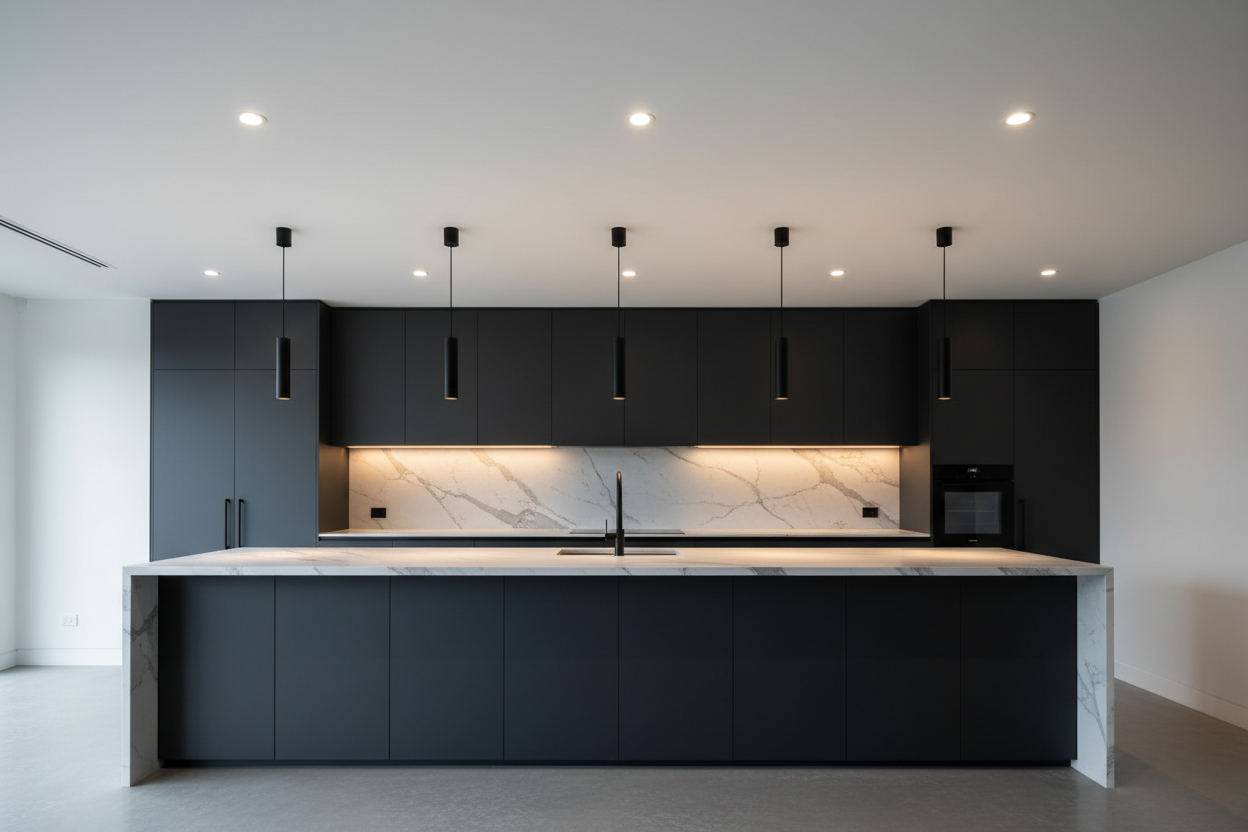
One of the most popular uses. Mount strips to the underside of overhead cabinets to throw direct task light onto the benchtop. Use Cool White (4000K) or Warm White (3000K) at 1000+ lm/m with a CRI of 90+.
Cove & Ceiling Recess Lighting
Strips recessed into a ceiling cove or bulkhead create a soft, indirect ambient glow. Use Warm White (3000K) at 500–1000 lm/m for a relaxed, residential feel.
Staircase Lighting
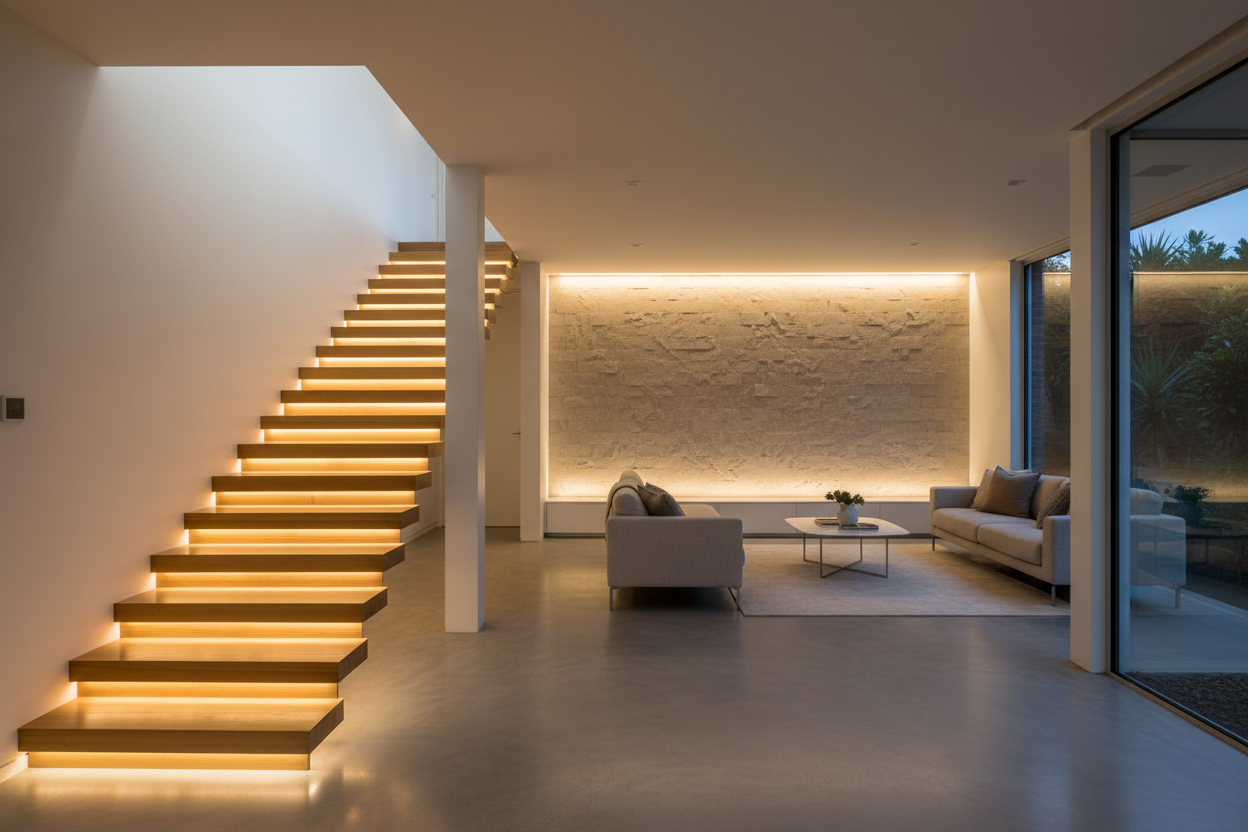
LED strips mounted along stair risers or beneath handrails add safety and style. Use an IP20 strip in a recessed stair-nose channel for a clean, flush finish.
Kickboard Lighting
Low-level strips along the base of kitchen or bathroom cabinetry create a floating effect. Particularly effective at night as a subtle wayfinding light. Warm White (3000K) at lower lumen outputs works best here.
Outdoor & Alfresco Lighting
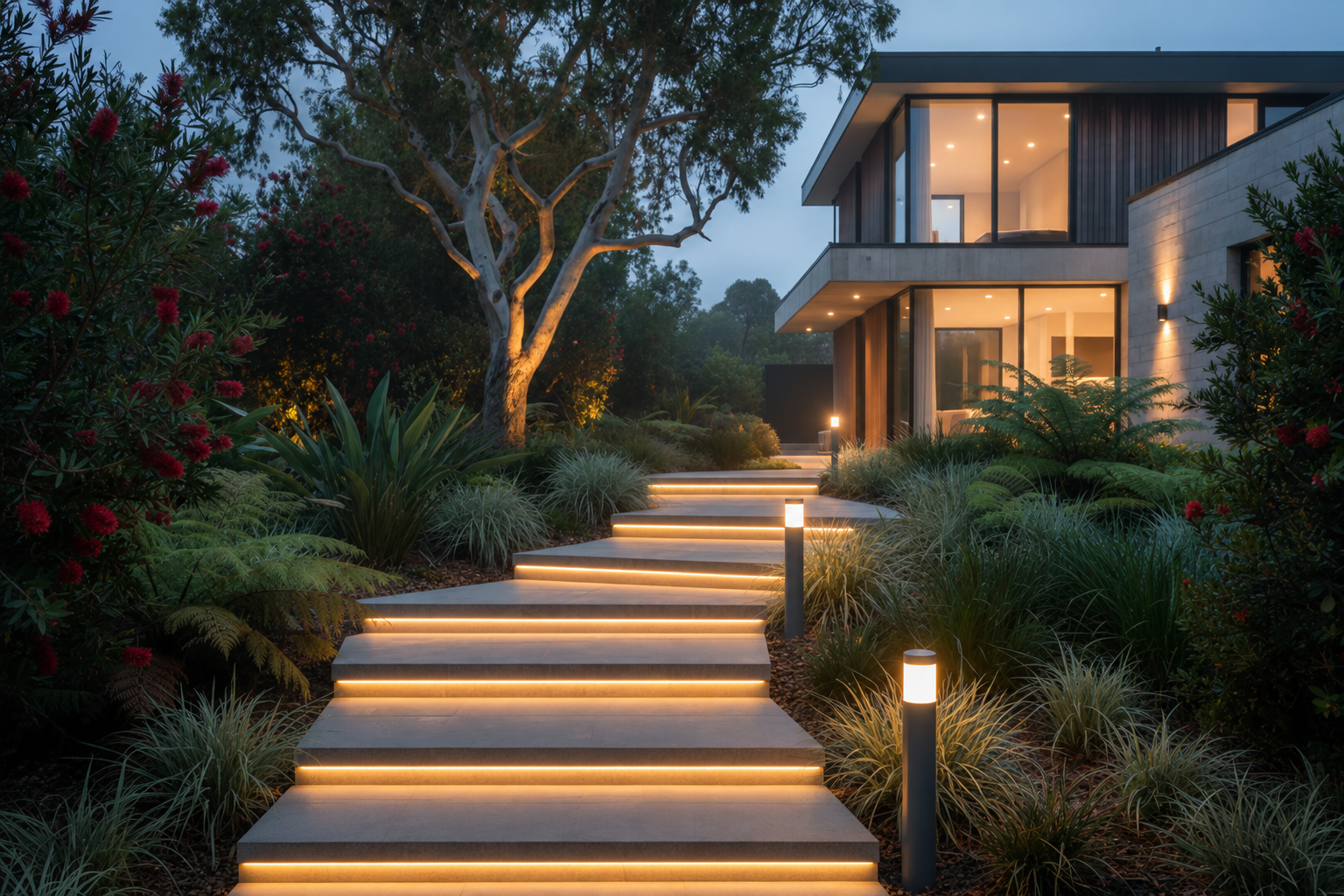
For covered outdoor areas, use a minimum IP65-rated strip. For exposed or wet areas, use IP67 or IP68. Pair with a weatherproof driver housed in a protected enclosure.
Shelving & Display Lighting
Strips inside display cabinets, bookshelves, or behind TV units add depth and highlight objects. Use a slim channel with a frosted diffuser for a premium finish.
LED Strip Kits vs. Individual Components
If you're new to LED strips, a pre-packaged LED strip kit is the easiest starting point. Kits typically include the strip, driver, and connectors — all matched and ready to install.
For more complex or custom installations, buying individual components gives you full control over length, brightness, colour temperature, and driver sizing.
Installation Tips
- Plan your run lengths before buying — calculate total metres needed and add 10% for waste and cuts
- Always cut at designated cut points — cutting between them will damage the circuit
- Use connectors for corners and joins — soldering is more reliable for permanent installations, but clip connectors work well for most DIY applications
- Secure strips properly — the adhesive backing is a starting point only; use mounting clips or a channel for a permanent, professional finish
- Keep drivers accessible — you may need to replace them over time; avoid burying them in inaccessible cavities
Frequently Asked Questions
What's the difference between LED strip and LED tape?
They're the same thing — LED strip, LED tape, and ribbon lighting all refer to the same flexible circuit board product.
How long do LED strips last?
Quality LED strips are rated for 30,000–50,000 hours of use. The driver often has a shorter lifespan — typically 20,000–30,000 hours — so factor this into your planning.
Can I cut LED strips to length?
Yes — most LED strips can be cut at designated cut points (usually every 50mm or 100mm). Always cut cleanly with sharp scissors at the marked line.
Can LED strips be used outdoors?
Yes, but you must use a strip with an appropriate IP rating for the environment. IP65 for covered outdoor areas, IP67/IP68 for exposed or wet locations.
Do I need an electrician to install LED strips?
The low-voltage strip itself can often be installed as a DIY project, but connecting the driver to 240V mains power must be done by a licensed electrician in Australia.
Ready to Shop LED Strip Lighting?
Browse our full range of LED strips, LED strip kits, channels and accessories, and drivers — everything you need for a professional result.