Whether you're building a new home, renovating, or simply upgrading your existing fittings, kitchen lighting is one of the most important — and most overlooked — elements of a well-designed space. Get it right and your kitchen feels bright, functional, and inviting. Get it wrong and you're left with shadows on your benchtop and a space that never quite feels finished.
This guide covers everything you need to know about kitchen lighting in Australia: the different types of lighting, where to place them, how to layer them, and what to look for when buying.
Why Kitchen Lighting Matters More Than You Think
The kitchen is the hardest-working room in the home. It's where you prep food, cook, eat, entertain, and often work. That means it needs to perform across multiple tasks and moods — from bright, focused light for chopping vegetables to warm, ambient light for a relaxed dinner.
A single overhead light (or worse, a single pendant) simply can't do all of that. The key to great kitchen lighting is layering — combining different types of light to cover every need.
The Three Layers of Kitchen Lighting
1. Ambient Lighting (General Illumination)
Ambient lighting is your base layer — the overall brightness that fills the room. In most kitchens, this comes from LED downlights recessed into the ceiling.
When planning ambient lighting for a kitchen:
- Spacing: As a general rule, space downlights roughly 1–1.2 metres apart and 600–700mm from walls.
- Colour temperature: Warm White (3000K) works well for open-plan kitchens that flow into living areas. Cool White (4000K) is popular in modern, contemporary kitchens and provides a crisper, more clinical feel ideal for food prep.
- Beam angle: A 60° beam angle is typically recommended for kitchens to provide even, overlapping coverage without harsh hotspots.
2. Task Lighting (Focused, Functional Light)
Task lighting targets specific work zones — benchtops, the sink, the cooktop, and the island. Without it, you'll often find yourself working in your own shadow.
The most effective task lighting options for kitchens include:
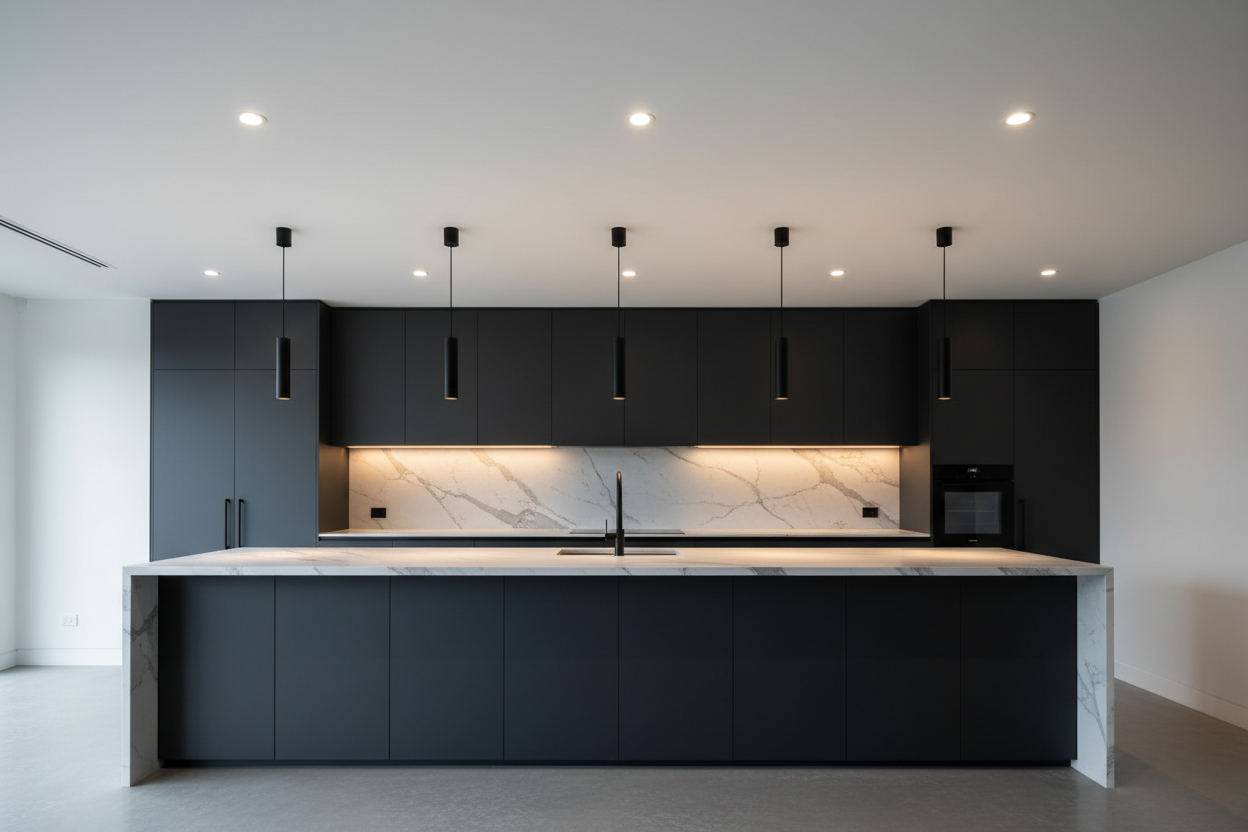
- Under-cabinet LED strip lighting: Mounted beneath overhead cabinets, LED strips throw direct light onto the benchtop below. They're low-profile, energy-efficient, and can be dimmable. Look for a high CRI (90+) so food colours appear natural and accurate.
- Recessed downlights over the island: A row of downlights directly above an island bench provides focused task light without the visual clutter of pendants (though pendants work well too — more on that below).
- Rangehood lighting: Most rangehoods include built-in lighting over the cooktop. If yours doesn't, consider a dedicated downlight positioned directly above.
3. Accent & Decorative Lighting (Atmosphere and Style)
Accent lighting adds depth, warmth, and personality to a kitchen. It's not strictly functional — it's about creating a space that feels considered and inviting.
Popular accent lighting options for kitchens:
- Pendant lights over an island or breakfast bar: One of the most impactful design choices in a kitchen. Pendants add visual height, define zones, and introduce style. Hang them 700–800mm above the benchtop surface for the best proportion.
- In-cabinet or display lighting: LED strip lighting inside glass-fronted cabinets highlights crockery or glassware and adds a premium feel.
- Kickboard lighting: Low-level LED strip lighting along the base of cabinetry creates a floating effect and subtle ambient glow — particularly effective at night.
Choosing the Right Colour Temperature for Your Kitchen
Colour temperature (measured in Kelvin) has a significant impact on how your kitchen looks and feels:
- Warm White – 3000K: Cosy and residential. Works well in traditional or Hamptons-style kitchens, or where the kitchen flows into a warm living area.
- Cool White – 4000K: Crisp and modern. Popular in contemporary and minimalist kitchens. Excellent for food prep but can feel cold in open-plan spaces.
- Daylight – 5000K+: Very bright and clinical. Best suited to commercial kitchens or task-heavy environments rather than residential spaces.
Pro tip: If you're using multiple light sources (downlights + LED strips + pendants), keep all fittings at the same colour temperature for a cohesive look.
Do You Need Dimmable Kitchen Lighting?
Yes — and it's worth planning for from the start. Dimmable lighting gives you full control over the mood and function of your kitchen at different times of day.
Bright light for morning prep. Softer light for evening dining. Dimmers let you do both without changing a single fitting.
To dim LED lighting correctly, you need:
- Dimmable LED downlights or strips
- A compatible LED dimmer switch (not all dimmers work with all LEDs — check compatibility before buying)
- A dimmable LED driver (for strip lighting)
For more detail, see our guide: LED Dimming Types Explained: What You Need to Know Before You Buy a Dimmer.
How Many Downlights Do You Need in a Kitchen?
A common starting point is one downlight per 1.2–1.5 square metres of ceiling area, but this varies based on:
- The lumen output of your chosen downlight
- Ceiling height (higher ceilings need higher-output fittings)
- Whether you're supplementing with task or accent lighting
For a more detailed breakdown, see our guide: How Many Lights Do You Need in a Room? A Complete Guide.
Kitchen Lighting Layout Tips
- Plan your layout before cabinetry is installed — it's much easier to position downlights correctly before overhead cabinets go in.
- Avoid placing downlights directly above cabinet doors — they'll cast shadows when the doors are open.
- Centre downlights between the benchtop edge and the overhead cabinet — this positions the light directly over your work surface.
- Use separate circuits for ambient, task, and accent lighting — this gives you independent dimmer control over each layer.
- Consider the island as its own zone — it often benefits from its own dedicated circuit and dimmer.
Frequently Asked Questions
What type of lighting is best for a kitchen?
A layered approach works best — LED downlights for ambient light, under-cabinet LED strips for task lighting, and pendants or accent lighting for atmosphere. No single fitting type can do it all.
What colour temperature is best for kitchen lighting in Australia?
Warm White (3000K) is the most popular choice for Australian kitchens — warm enough to feel residential, bright enough for cooking and prep. Contemporary kitchens often use Cool White (4000K) for a crisper, more modern feel.
How far apart should downlights be in a kitchen?
Space downlights 1–1.2 metres apart for even coverage, and position them 600–700mm from walls to avoid scalloping effects on cabinetry.
Can I use LED strip lighting under kitchen cabinets?
Yes — under-cabinet LED strips are one of the most effective task lighting solutions for kitchens. Look for a high CRI (90+), a dimmable option, and ensure you pair them with a compatible LED driver.
Do I need an electrician to install kitchen lighting?
In Australia, all fixed electrical work must be carried out by a licensed electrician. This includes installing downlights, LED drivers, and dimmer switches.
Ready to Light Your Kitchen?
Great kitchen lighting starts with the right products. Browse our full range of LED downlights, LED strip lighting, pendants, and dimmers — and find everything you need for a beautifully lit kitchen.